
A website can have great products, attractive design, and useful information and still struggle to appear in Google Search. The reason is often not the quality of the business itself, but how effectively the website is optimized for search.
Understanding the types of SEO optimization helps you identify what needs improvement instead of randomly changing keywords, publishing more content, or building links without a clear strategy.
Introduction
The types of SEO optimization are different approaches used to improve a website’s visibility, accessibility, relevance, and search performance. SEO is not one single activity. It combines content improvements, technical work, authority building, local visibility, and other optimizations that help search engines understand and surface useful pages.
Google’s current guidance emphasizes helpful, reliable, people-first content, crawlable websites, good page experience, and clear page information rather than tactics designed simply to manipulate rankings.
In this guide, you’ll learn the major types of SEO optimization, what each one does, practical examples, common mistakes, and how to build a simple SEO process for a business website.
The Problem: SEO Is Often Treated as Just Keywords
One of the biggest misconceptions about SEO is that ranking depends mainly on placing a keyword repeatedly throughout a page.
That approach misses much of the work involved. A page may use the right keyword but still have technical problems, weak content, poor internal linking, limited authority, or a poor mobile experience.
Google specifically describes excessive repetition of keywords as keyword stuffing and considers it a form of spam.
This is why learning the types of SEO optimization is more useful than focusing on keyword frequency alone.
Why Understanding the Types of SEO Optimization Matters
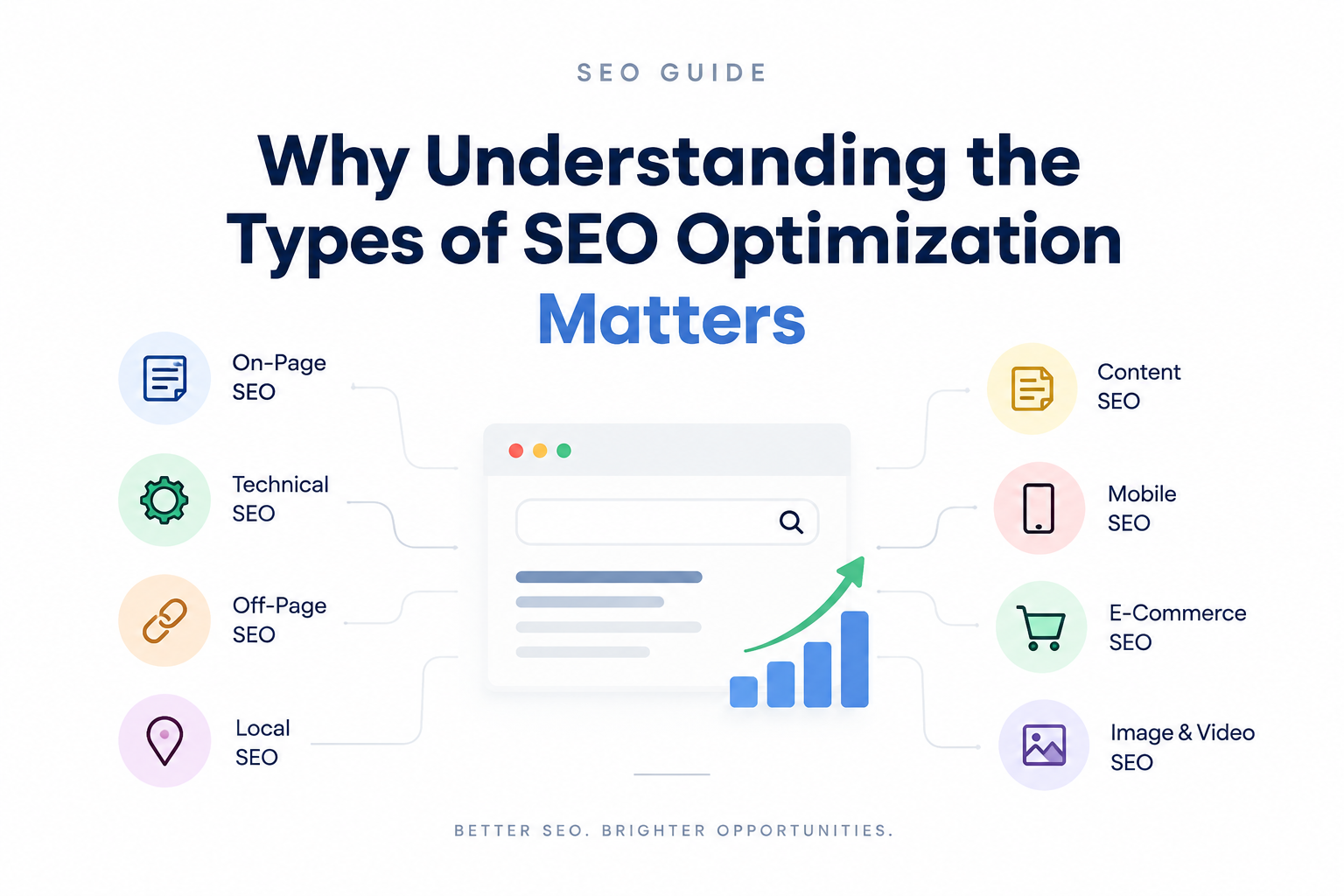
SEO works as a system. A technically accessible website with poor content may not satisfy search intent. A great article with indexing problems may not be discovered properly. A local business page may attract visitors but fail to provide the location information people need.
Knowing the different types of SEO optimization allows you to:
- Diagnose SEO problems more accurately.
- Prioritize work based on business goals.
- Improve both search visibility and user experience.
- Build a more sustainable organic search strategy.
- Measure which activities are contributing to growth.
There is no single official list of SEO categories that every practitioner follows. The classifications below are a practical way to organize the major areas of SEO.
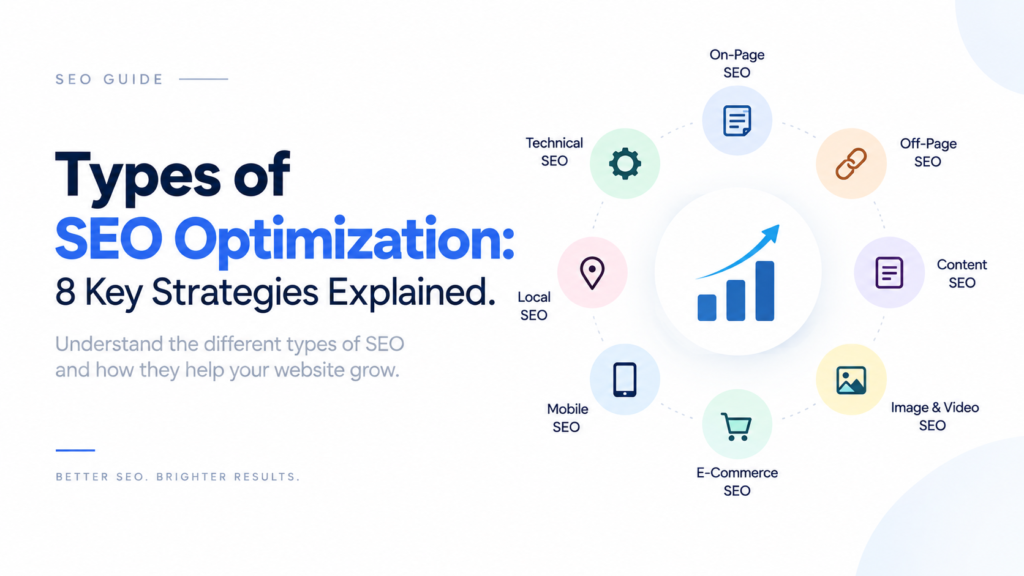
8 Major Types of SEO Optimization
1. On-Page SEO Optimization
On-page SEO involves optimizing the content and elements found within a website page to make it clearer and more useful for both search engines and visitors. It is a key part of SEO optimization because it helps search engines better understand the topic, purpose, and relevance of each page.
Key on-page elements
Optimize:
- Page titles
- Headings
- Main content
- URLs
- Meta descriptions
- Internal links
- Images and alternative text
- Relevant keyword variations
- Content structure
For example, suppose you operate a digital marketing service in Kerala. Instead of creating a generic page titled “Services,” a more descriptive page such as “Digital Marketing Services in Kerala” gives users and search engines clearer context.
However, optimization should remain natural. Google’s documentation notes that its systems can understand related search terms and variations, so you don’t need to repeat an exact phrase every time.
2. Technical SEO Optimization
Technical SEO focuses on how search engines crawl, render, index, and access your website.
This is another major category among the types of SEO optimization and is particularly important as websites become more complex.
Important technical SEO areas
Common tasks include:
- Checking indexability.
- Creating and maintaining XML sitemaps.
- Reviewing robots.txt.
- Fixing broken links and unwanted redirects.
- Managing canonical URLs.
- Improving page loading performance.
- Ensuring HTTPS security.
- Checking JavaScript rendering.
- Making important content accessible to search engines.
Google explains that technical issues can prevent search engines from properly accessing or understanding website content. Its developer documentation also recommends websites that are secure, fast, accessible, and usable across devices.
Example
Imagine an article is published but accidentally marked noindex. The content can be excellent, but Google may not include that page in its search index.
Technical SEO helps prevent problems like this.
3. Off-Page SEO Optimization
Off-page SEO refers to strategies carried out beyond your own website to strengthen its online authority, credibility, and overall search visibility. These efforts can include earning quality backlinks, gaining brand mentions, and building relationships with relevant websites.
Among the types of SEO optimization, off-page SEO is commonly associated with links, digital PR, brand mentions, partnerships, and other external signals.
Common off-page activities
Examples include:
- Earning relevant backlinks.
- Digital PR.
- Industry publications.
- Business partnerships.
- Expert contributions.
- Brand mentions.
The goal is to build genuine, high-quality backlinks from relevant and trustworthy websites instead of using paid or manipulative link-building practices to influence search rankings.
Google’s spam policies specifically identify practices such as buying links for ranking purposes, excessive link exchanges, and automated link creation as examples of link spam.
4. Local SEO Optimization
Local SEO is designed for businesses that serve customers in particular geographic areas.
It is one of the most valuable types of SEO optimization for businesses such as restaurants, clinics, agencies, salons, repair services, shops, consultants, and local professionals.
Local SEO involves
- Optimizing your Google Business Profile.
- Maintaining consistent business information.
- Creating useful location-based content.
- Earning relevant local mentions and links.
- Collecting and managing genuine customer reviews.
- Building location-specific service pages where appropriate.
Example
A photographer serving Kochi should not rely only on a general “photography services” page.
Pages and content addressing relevant services and locations can help users understand exactly what the business offers and where it operates.
Local SEO should still provide genuine value. Creating dozens of nearly identical location pages with little useful information can result in poor user experiences.
5. Content SEO
Content SEO involves developing and refining website content to address the topics, questions, and needs that users are actively searching for.
This area sits at the center of many types of SEO optimization because search visibility ultimately depends on having useful pages that satisfy search intent.
Effective content SEO involves
Before creating an article, understand:
- What the user is trying to accomplish.
- Identify whether the search is intended to find information, compare or consider products or services, reach a specific website, or make a purchase.
- What questions the searcher is likely to have.
- What level of knowledge the audience has.
- What unique information you can provide.
Google’s people-first guidance encourages content created primarily to help users rather than content created mainly to manipulate search rankings.
Example
For the topic “Instagram marketing for small businesses,” a useful article could explain content planning, audience research, post formats, measurement, and practical examples.
Simply repeating “Instagram marketing” dozens of times would add little value.
6. Mobile SEO Optimization
Mobile SEO focuses on making your website work effectively on smartphones and other mobile devices.
It is an essential part of modern types of SEO optimization because Google primarily uses the mobile version of a site’s content for indexing for most websites.
Mobile SEO checklist
Check whether:
- Text is easy to read without zooming.
- Buttons are easy to tap.
- Important content appears on mobile.
- Images display correctly.
- Navigation works properly.
- Pages load efficiently.
- Mobile users can complete important actions easily.
Google recommends responsive web design as an implementation approach because it serves the same HTML and URL while adapting the display to different screen sizes.
7. E-commerce SEO Optimization
E-commerce SEO applies SEO principles to online stores and product-driven websites.
Among the types of SEO optimization, e-commerce SEO has an additional challenge: there may be hundreds or thousands of product, category, filter, and pagination URLs.
Important areas include
- Product titles and descriptions.
- Category page optimization.
- Search-friendly product URLs.
- Product images and alt text.
- Internal linking.
- Structured data where appropriate.
- Managing duplicate or thin pages.
- Improving product discovery.
- Optimizing category and collection architecture.
Structured data can help Google understand page content and can make pages eligible for certain rich-result appearances, although Google does not guarantee that structured data will always produce a rich result.
8. Image and Video SEO
Search visibility is not limited to traditional blue-link results. Google Search also includes image and video experiences, making visual optimization another useful category among the types of SEO optimization.
Image SEO includes
- Descriptive file names.
- Relevant alternative text.
- Appropriate image formats.
- Proper image dimensions.
- Useful surrounding text.
- Fast loading.
Video SEO includes
- Descriptive titles.
- Clear descriptions.
- Useful thumbnails.
- Relevant page context.
- Proper technical implementation.
The goal is not to add keywords to every image field. Instead, describe images accurately and make visual content useful and accessible.
How to Choose the Right Types of SEO Optimization
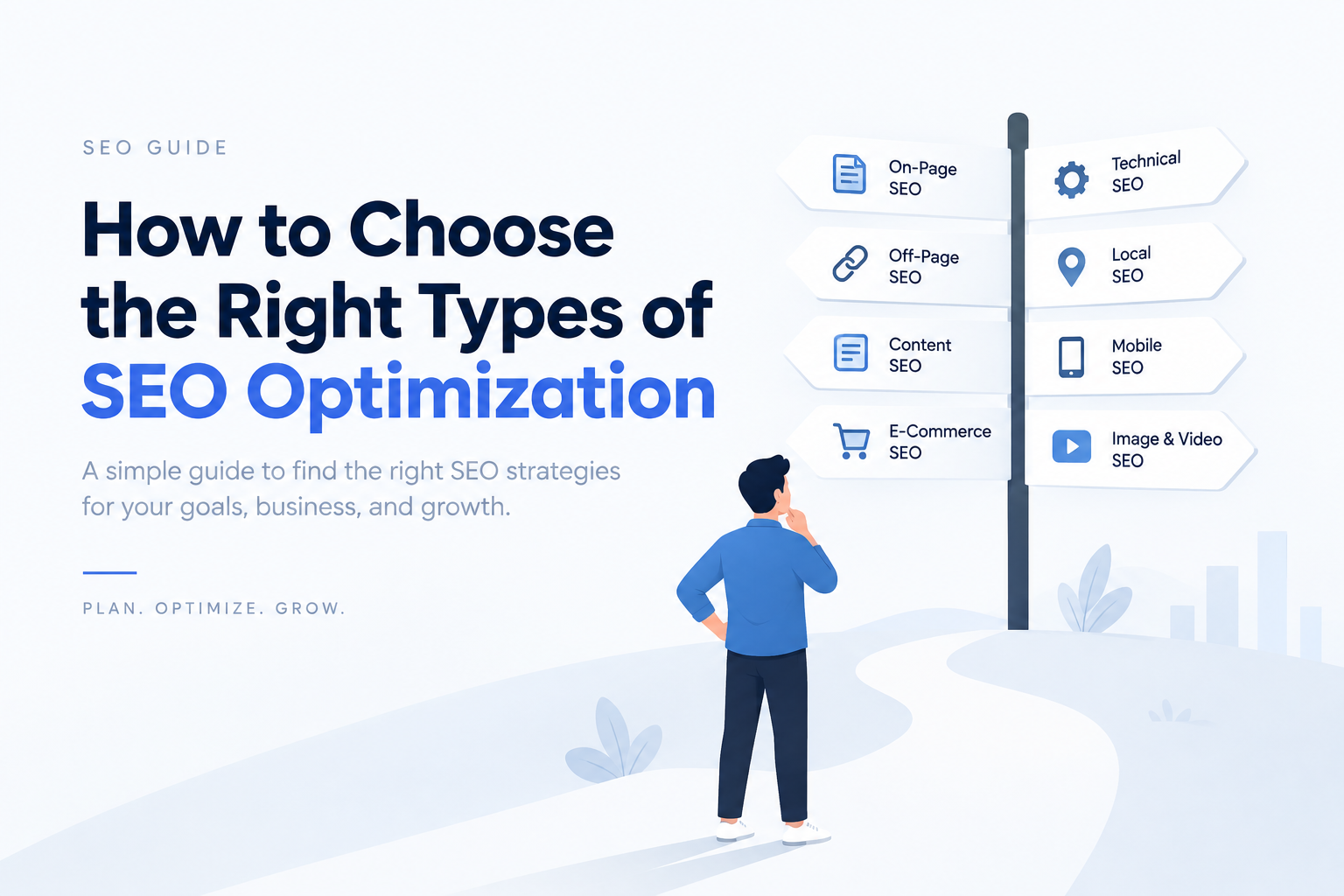
You don’t need to implement every SEO activity at once.
Start by identifying your biggest business and website problems.
For a new website
Prioritize:
- Technical accessibility and indexing.
- Site structure.
- Keyword and search-intent research.
- Useful core pages.
- Mobile usability.
- Measurement and tracking.
For an established website
Focus on:
- Existing content improvements.
- Technical issues.
- Internal linking.
- Search performance opportunities.
- Authority and link acquisition.
- Conversion-focused optimization.
Google Search Console can show queries, pages, clicks, impressions, click-through rate, and average position, helping you identify pages and searches that deserve attention. Google also recommends focusing on performance trends rather than position alone.
A Practical SEO Workflow for Beginners
Instead of treating the types of SEO optimization as isolated tasks, connect them into a repeatable workflow.
Step 1: Research the audience
Identify the problems, questions, products, and services your target audience searches for.
Step 2: Map keywords to pages
Avoid creating separate pages for closely related keyword variations; instead, combine them into one comprehensive page that covers the broader search topic. Group closely related search terms around a useful page.
Step 3: Fix technical problems
Make sure important pages can be crawled, rendered, indexed, and accessed properly.
Step 4: Improve existing pages
Strengthen weak content before automatically creating more content.
Step 5: Build internal links
Use internal links between related pages to help visitors navigate your website and make important content easier for search engines to find and understand.
Step 6: Build genuine authority
Earn mentions and links through useful resources, partnerships, research, digital PR, and strong content.
Step 7: Measure results
Use Search Console to examine clicks, impressions, CTR, queries, and pages. Analytics can then help you understand what visitors do after they arrive through organic search.
Common SEO Mistakes to Avoid
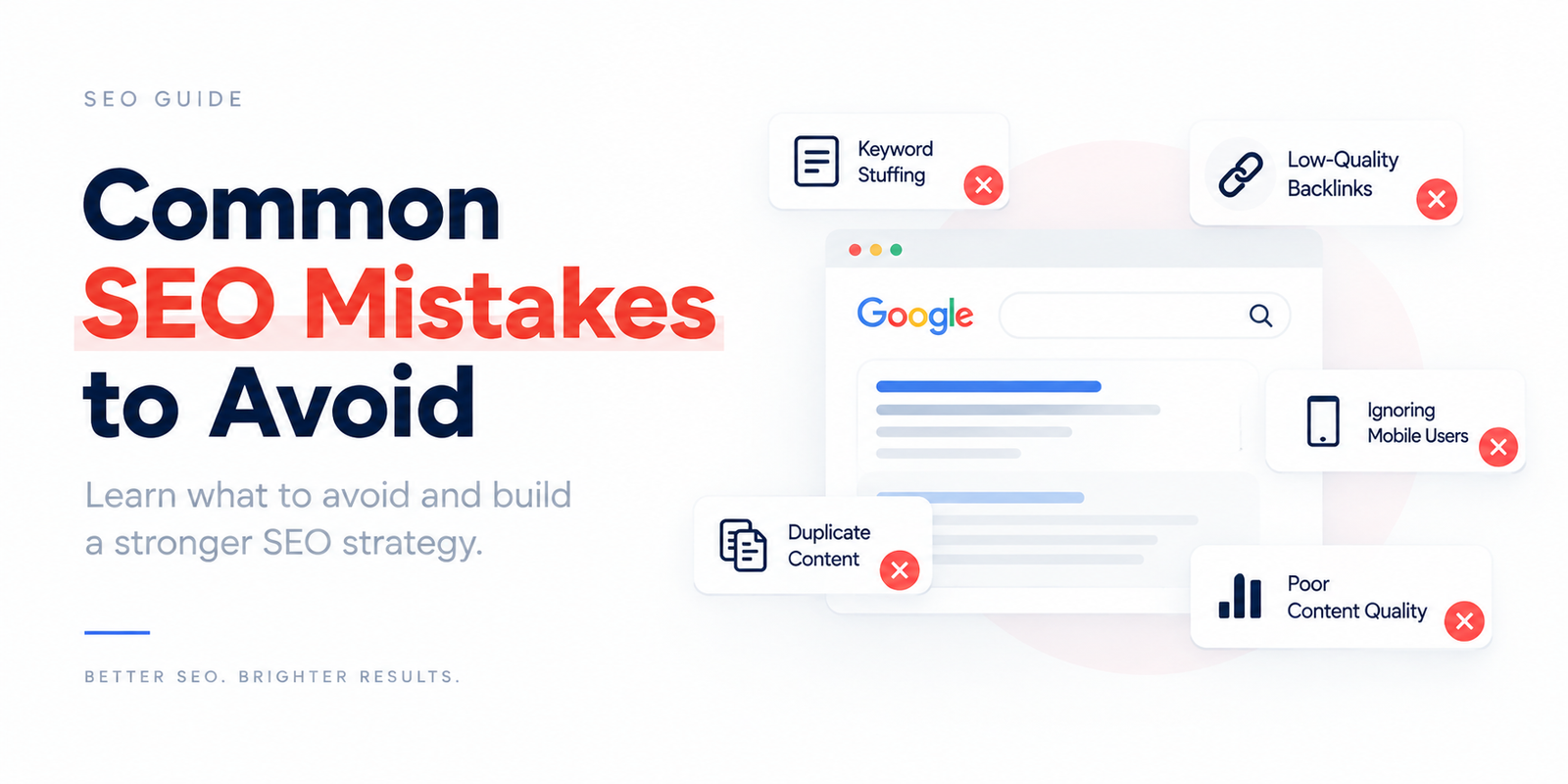
Mistake 1: Obsessing Over Keyword Density
Trying to hit an exact percentage can make writing unnatural.
Google’s spam policies explicitly warn against repeating keywords so frequently that the page sounds unnatural.
Do instead: Use the main topic naturally and cover related questions thoroughly.
Mistake 2: Publishing AI-Generated Filler
Producing large quantities of generic articles without adding useful information can weaken the quality of your website.
Do instead: Add original examples, experience, analysis, useful visuals, and information that actually helps the audience.
Mistake 3: Ignoring Technical SEO
Use internal links between related pages to help visitors navigate your website and make important content easier for search engines to find and understand. .
Do instead: Regularly inspect important URLs and monitor Search Console for technical issues.
Mistake 4: Building Links at Any Cost
Purchasing backlinks or using deceptive link-building tactics may go against Google’s guidelines and could negatively affect a website’s search visibility.
Do instead: Create resources worth referencing and pursue relevant, legitimate promotional opportunities.
Mistake 5: Optimizing Only for Google
A page that ranks but frustrates visitors is not a strong long-term result.
Do instead: Improve clarity, navigation, mobile usability, accessibility, and the overall page experience. Google’s current guidance encourages site owners to consider page experience holistically.
SEO Tools to Support Your Strategy
A practical SEO workflow can start with a small set of tools.
Google Search Console
Use it to understand how your site appears in Google Search, including queries, pages, clicks, impressions, CTR, and average position.
Google Analytics
Use Analytics to understand what visitors do after arriving through organic search, including engagement and conversions that matter to your business.
PageSpeed Insights
Useful for evaluating page performance and identifying opportunities to improve the user experience.
Keyword and competitor research tools
Platforms such as Semrush, Ahrefs, and similar tools can help with keyword discovery, competitor analysis, backlinks, and content research. Use them to support decision-making rather than treating their scores as guarantees of rankings.
FAQs About Types of SEO Optimization
What are the main types of SEO optimization ?
The main types of SEO optimization commonly discussed are on-page SEO, technical SEO, off-page SEO, local SEO, content SEO, mobile SEO, e-commerce SEO, and image or video SEO.
Which type of SEO is most important?
There is no single SEO category that works independently of the others. A useful strategy combines technical accessibility, relevant content, strong page optimization, good user experience, and appropriate authority-building activities.
Is technical SEO necessary for a small business?
Yes. Small businesses still need important pages to be crawlable, indexable, mobile-friendly, secure, and technically accessible. Technical SEO does not necessarily mean complex development work; many issues can be identified through basic website audits and Search Console.
What is the difference between on-page and off-page SEO?
On-page SEO focuses on elements you control directly on your website, such as content, headings, titles, URLs, and internal links. Off-page SEO focuses on external signals and activities, such as earning relevant backlinks and building brand authority.
Does local SEO count as one of the types of SEO optimization?
Yes. Local SEO is a distinct area focused on improving visibility for location-based searches and connecting businesses with customers in specific geographic areas.
How long does SEO take to show results?
SEO results vary significantly depending on factors such as website history, competition, content quality, technical condition, authority, and search demand. There is no reliable universal timeline for ranking improvements.
Can I do SEO without hiring an agency?
Yes. Many fundamental SEO tasks can be learned and implemented in-house. Smaller websites can begin with Google Search Console, website audits, search-intent research, content improvements, internal linking, and basic technical optimization.
Key Takeaways
- The types of SEO optimization cover different parts of a website and its search presence.
- On-page SEO improves the information and structure of individual pages.
- Technical SEO helps search engines access, render, and index important content.
- Off-page SEO focuses on building legitimate external authority.
- Local SEO helps businesses attract customers who are searching for products or services in specific locations. Content SEO, on the other hand, aims to provide relevant and valuable information that matches the user’s search intent.
- Content SEO focuses on satisfying search intent with useful information.
- Mobile, e-commerce, image, and video SEO address specific search and website needs.
- Keyword repetition should never replace useful content.
- Search Console provides practical data for measuring search performance.
- SEO works best as an integrated system rather than a collection of isolated tricks.
Conclusion
Understanding the types of SEO optimization gives you a clearer way to diagnose problems and decide what to improve first.
Rather than concentrating only on keyword usage, consider broader SEO factors such as whether search engines can access the page, understand its content, and deliver a good experience to visitors. Does the content answer the searcher’s question? Is the page useful on mobile? Does the site have a logical structure? Are other relevant websites referencing the brand or content?
That shift from keyword placement to complete search optimization creates a much stronger foundation for sustainable SEO.
For akshaykumarkv.in, the practical next step is to audit the site across technical SEO, on-page SEO, content quality, local visibility, internal linking, and search performance, then prioritize the issues that have the clearest business impact.